
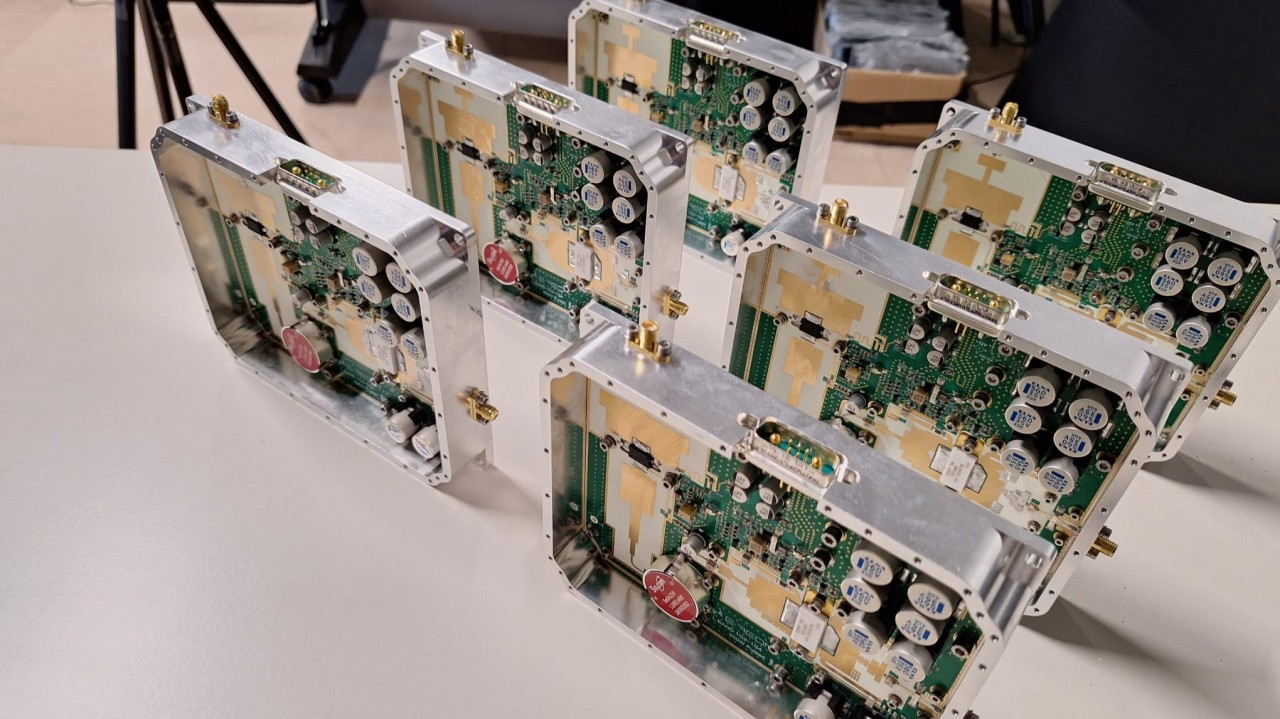
An RF amplifier may meet the required frequency range, output power and gain, yet still be difficult to integrate into the intended equipment.
Its dimensions or mounting interface may be incompatible with the available cooling arrangement. The application may require a different control interface or specific behaviour following a fault. Several RF channels may need to share an enclosure and power supply while communicating with a common supervisory controller, as in multi-channel counter-UAS systems.
When these constraints cannot be relaxed, the engineering task is to determine whether a standard amplifier can be integrated as supplied, whether the surrounding subsystem can accommodate it, or whether application-specific hardware is required.
At E-REON, we design and build our RF hardware in-house at our EU premises. Our work covers RF circuit and matching-network design, mechanical and thermal engineering, embedded control, assembly and validation. This allows us to address constraints directly—through changes to the amplifier design, its physical implementation or the surrounding subsystem.
When a standard amplifier is enough
A commercial off-the-shelf (COTS) amplifier is often the right final solution when its lead time fits the project schedule and its documented performance and integration requirements match the application.
Assessing its suitability requires examining the conditions behind the headline specifications: the intended waveform, acceptable distortion, duty cycle, supply voltage, current consumption, cooling requirements and load-mismatch tolerance. Mechanical interfaces, control behaviour and long-term supply availability also belong in that assessment.
If the product meets these requirements, there is usually little benefit in modifying it or commissioning dedicated development. The remaining work is to install it correctly and verify its behaviour within the complete system.
When a requirement cannot be relaxed and falls outside the available product's capabilities or configuration, the next question is practical:
Can an existing design be adapted, or does the application require a different RF architecture?
Working with the design source
An existing amplifier design can provide a useful basis for adaptation. The question is whether the supplier can modify the underlying design, propose practical ways to accommodate the required changes, and evaluate their technical feasibility and effect on the resulting hardware.
At E-REON, RF design and physical implementation are developed in-house. Depending on the application, adaptation can involve the amplifier circuit, analogue and control circuitry, protection functions, connector arrangement, housing or thermal interface.
These changes are often coupled. Selecting a different RF power device or adding protection circuitry may affect board dimensions, enclosure geometry and connector positions. A revised operating level can change heat dissipation and power-supply requirements. Changes to control sequencing can affect startup, shutdown and fault response.
Direct access to the underlying design allows us to assess these interactions before committing to modifications and define the validation needed to address the resulting risks. It also helps establish whether adapting an existing design is sensible or a new implementation is justified.
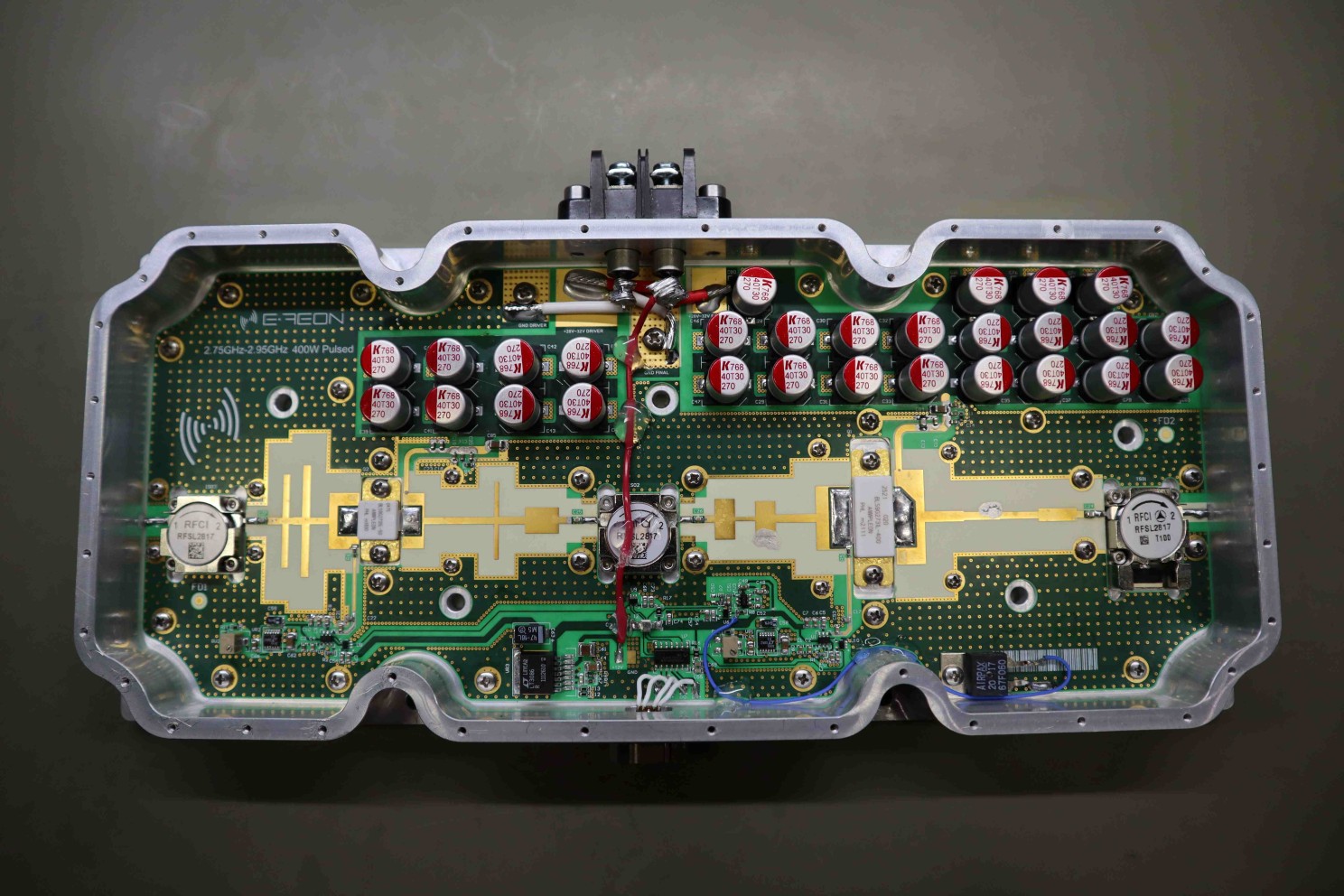
An E-REON 400 W pulsed S-band amplifier implementation showing the RF circuitry, supporting electronics and aluminium housing.
When the surrounding subsystem can be simplified
Sometimes the core amplifier is suitable, while the equipment around it requires substantial development. Integrating additional functions into the amplifier assembly can simplify the wider system and reduce the number of separate modules, connections and control interfaces.
For example, an RF power amplifier may meet the RF requirements under its specified operating conditions, but the intended system enclosure has a different airflow arrangement. Several amplifier channels may also need to operate simultaneously, with shared power distribution, remote monitoring and coordinated fault handling.
The engineering work may include:
- defining the thermal interface and heat-removal arrangement;
- integrating power distribution, sequencing and enable control;
- adding forward and reflected power sensing;
- implementing supervisory electronics and fault handling;
- incorporating filters, switches, attenuators and internal RF connections;
- designing the enclosure for assembly and service access.
This is a practical reason to approach E-REON even when the core amplifier has already been selected. We can integrate the required signal conditioning, mechanical, thermal and control functions into an amplifier subsystem, with defined interfaces and validation against the intended operating conditions.
The same approach applies to our established designs: retain suitable RF hardware, then develop and validate the additional functions required by the application.
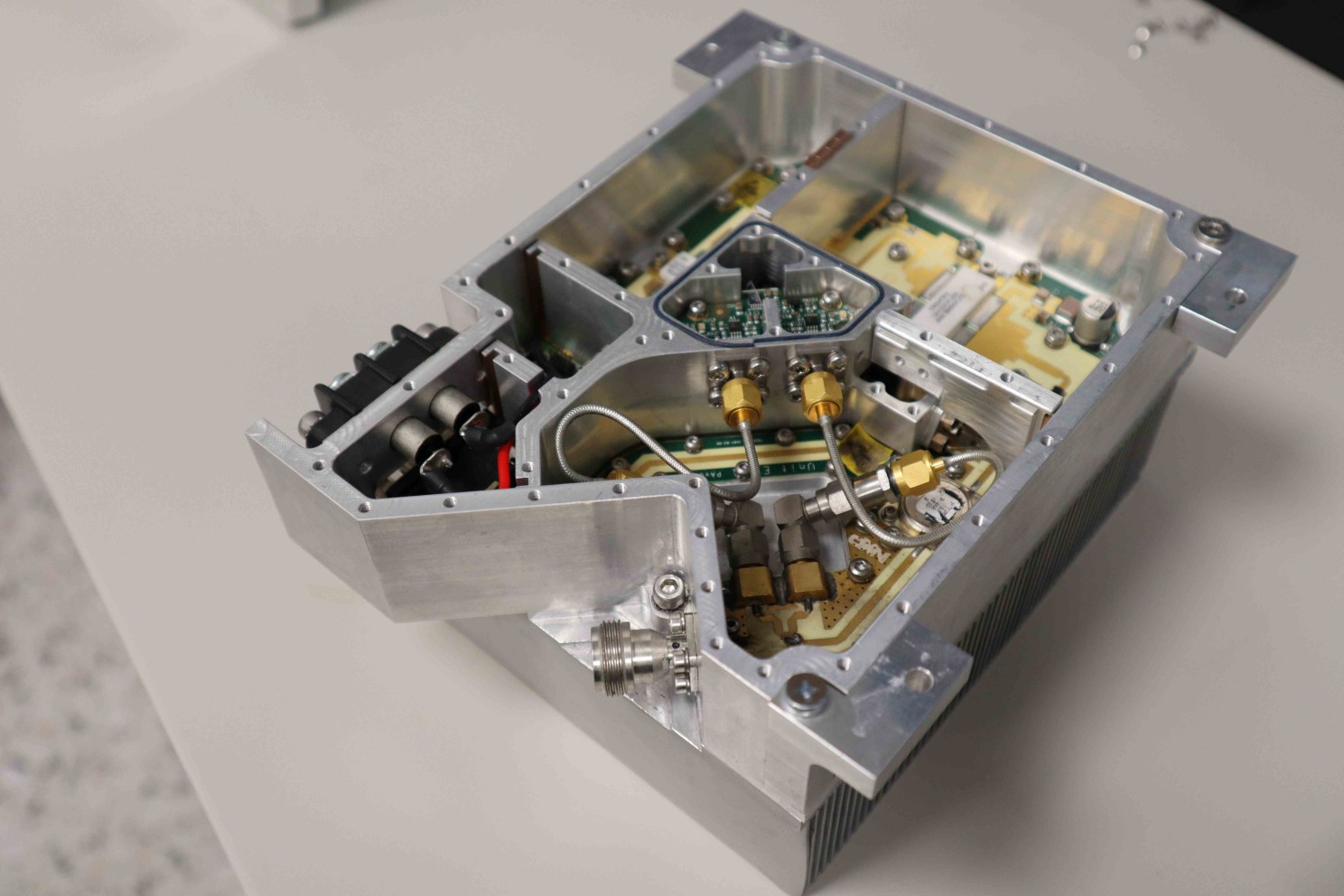
An E-REON integrated RF assembly with embedded control, forward and reflected power monitoring, fault handling and an integrated heatsink.
When dedicated RF hardware is justified
Custom amplifier development becomes relevant when adapting an available product would impose excessive compromises on the system or leave significant uncertainty about the final performance.
The requirement may involve a particular combination of bandwidth, output power and allowable distortion, or specific pulse-to-pulse performance. Other drivers can include RoHS compliance, component availability and lead times, suitability for volume production, or a target unit cost. Integrating a signal source, adding or removing gain stages, or operating from a different supply voltage may also justify a dedicated design.
In these cases, E-REON can develop the RF circuit and its supporting implementation together. Frequency coverage and output power are considered alongside gain allocation, bias, power delivery, thermal loading, protection, mechanical constraints and manufacturing requirements.
The engineering decision is whether to retain an existing design, modify it or begin a new development. Each route must be assessed against technical risk, validation effort, schedule and total cost across the expected production volume.
From a design to repeated production
When hardware must be supplied repeatedly, manufacturing consistency, traceability and documentation become part of the engineering requirement.
The circuit, bill of materials, component traceability records, assembly instructions, and test and burn-in procedures must remain tied to a defined design revision. Where the application requires industrial-grade or aerospace- and defence-qualified components, those requirements must be specified and reflected in procurement. The same applies to restrictions on component origin and approved sourcing countries.
A successful first unit provides limited assurance about later builds unless the relevant design, sourcing, assembly and verification conditions are controlled.
E-REON carries out design and build in-house, maintaining continuity between development, assembly, troubleshooting and subsequent changes. Our amplifier work includes both individual development assemblies and production batches.
That continuity matters when a customer needs an integration change, encounters unexpected behaviour or orders further units. The engineering team can return to the documented design and build information, assess the impact of a proposed change, and determine what must be verified before it enters production.
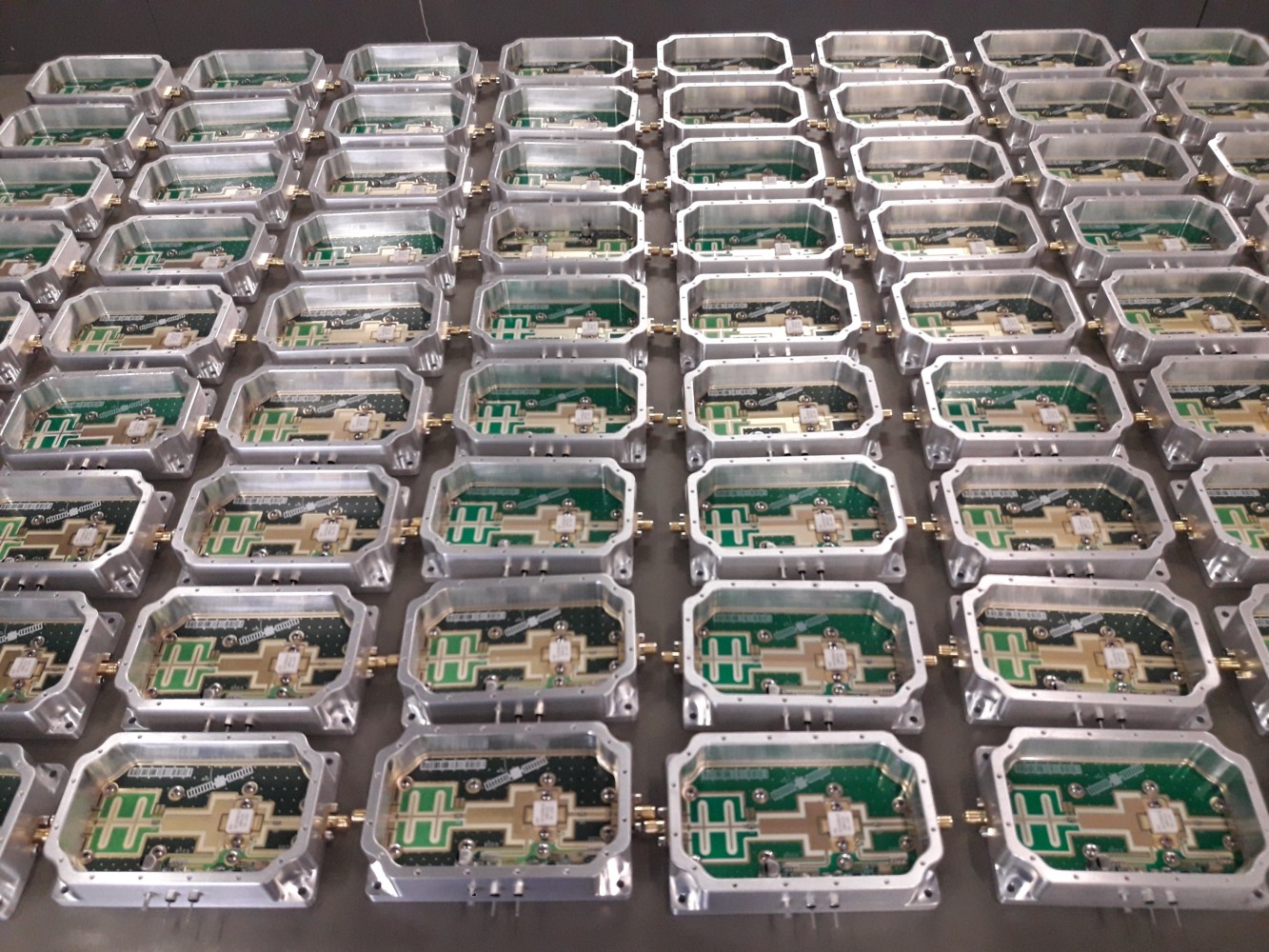
E-REON amplifier modules assembled in-house during a production batch.
What to bring to the engineering discussion
A useful starting brief includes the frequency range, waveform, required output level, duty cycle, available power, cooling conditions, mechanical envelope and control interfaces. Expected quantities and supply requirements help establish the appropriate development route.
If hardware has already been selected or tested, the remaining limitation is especially useful: what works, under which conditions, and what prevents integration?
From that basis, E-REON can assess whether an existing amplifier platform is suitable, whether adaptation or surrounding subsystem development is needed, or whether the requirement calls for dedicated RF hardware.
Working directly with the team that designs and builds the hardware makes that decision actionable—from the RF circuit through integration and into production.